📖 Source
FHA well water requirements are defined in HUD Handbook 4000.1, Section II.A.1.a and Section III.A.3.a. Lenders are required to follow this handbook when underwriting FHA-insured loans.
When FHA Requires a Well Water Test
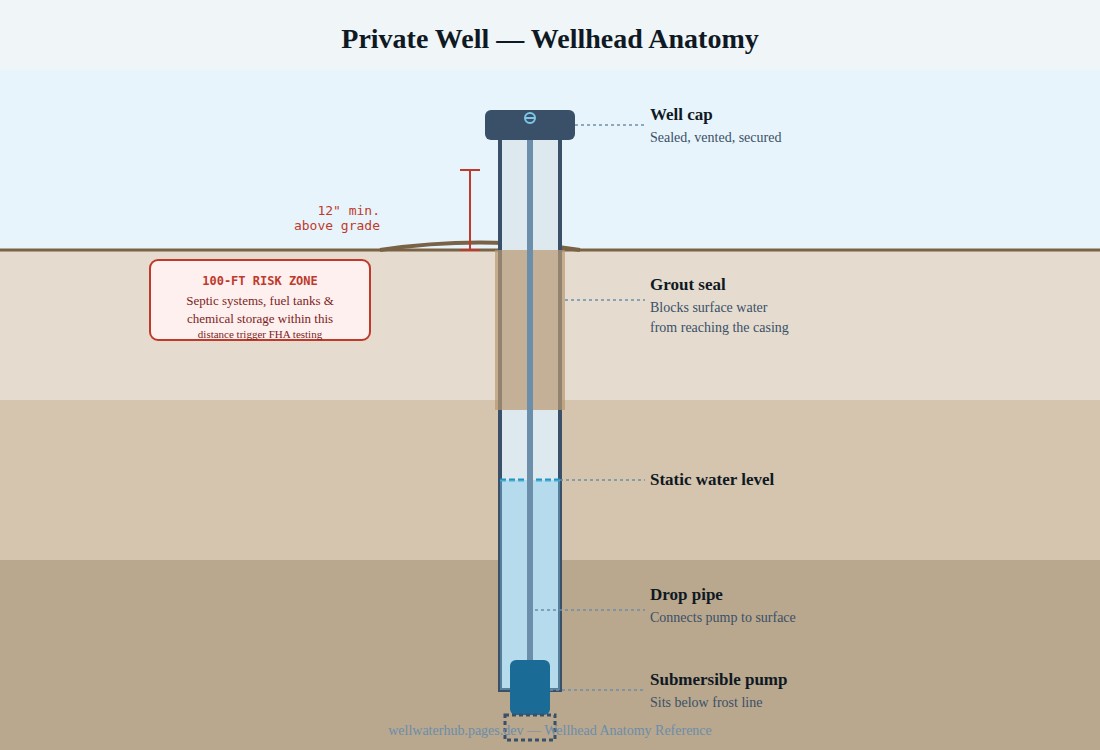
FHA does not require water testing on every well automatically. Testing is triggered by specific risk proximity factors that the FHA appraiser identifies during the property inspection. Testing is required when any one of the following conditions exists:
- The well is within 100 feet of a septic system (including drain/leach field)
- The well is within 100 feet of an underground fuel storage tank
- The well is within 100 feet of other pollution sources identified by the appraiser (chemical storage, industrial waste, farm runoff pits)
- The property has a shared well serving two or more properties
- The local health authority or state law requires testing
- The appraiser observes visible signs of contamination risk not covered above
⚠ In Practice: Almost Always Required
The 100-foot septic proximity rule catches the vast majority of rural properties. Most homes on private wells also have on-site septic systems, and a 100-foot separation is a relatively small distance on rural lots. If the property has both a well and a septic system, assume testing will be required.
What FHA Requires the Test to Cover
FHA does not publish a universal panel list—instead, it requires that results meet EPA Maximum Contaminant Levels (MCLs). In practice, lenders and local HUD field offices have established standard minimum panels. Most FHA transactions require testing for:
- Total coliform bacteria (must be absent)
- E. coli (must be absent)
- Nitrate (must be ≤10 mg/L)
- Lead (must be ≤0.015 mg/L)
- pH (must be 6.5–8.5)
- Any contaminants specifically required by the local health authority
Your FHA lender or the local HUD Homeownership Center may require additional parameters based on regional concerns (arsenic in New England, radon in certain areas, VOCs near industrial zones). Ask your lender for the specific panel they require before ordering the test.
Who Must Conduct the Test
The test must be conducted by a state-certified laboratory holding NELAP certification (or the state’s equivalent certification program). DIY kits and uncertified labs are not accepted for FHA purposes.
The lab’s report must show:
- The lab’s state certification number
- Date of sample collection
- Results for each parameter tested
- The applicable standard (MCL) for comparison
- Pass/fail notation or a clear comparison to limits
Find a state-certified lab near you →
How Long FHA Test Results Are Valid
FHA defers to the local health authority’s determination on test validity. In practice, most FHA lenders and underwriters accept results that are no more than 90–180 days old at the time of closing. The 90-day standard is the more conservative interpretation used by many lenders.
To avoid any ambiguity, order the well water test at the time of the home inspection—not at the end of the contingency period. If the test is ordered early and results come back clean, they will remain within any reasonable validity window through a normal 45–60 day closing timeline. Full validity guide →
Who Pays for FHA Well Water Testing
FHA guidelines do not designate a required payer. The cost is negotiable between buyer and seller as part of the purchase agreement. Common arrangements:
- Seller pays: Common in buyer’s markets or when the seller is motivated. Sellers often prefer to test before listing to avoid surprises.
- Buyer pays: Common in competitive markets. Buyer treats it as part of the inspection cost.
- Split: Some transactions split the cost, particularly if a follow-up test is needed after remediation.
Typical cost for an FHA-standard panel: $150–$350 at a certified lab. See our full cost guide →
What Happens If FHA Well Water Results Fail
A failing result (any parameter exceeds the MCL) does not automatically kill the transaction, but the loan cannot close until the well passes a re-test. The standard process:
- Determine the cause and treatment
Bacteria failure: shock chlorination. Nitrate failure: nitrate-specific filtration (RO or ion exchange). Lead failure: investigate plumbing; consider NSF-53 filter at point of use. pH failure: neutralizer or adjustment system. The remediation approach must match the specific contaminant.
- Negotiate who pays for remediation
This becomes a contract negotiation point. The seller has no legal obligation in most states, but the lender requires a passing test to fund the loan. Practically, remediation responsibility falls to whoever has the most motivation to close.
- Complete remediation and wait
For bacteria, wait at least 7–14 days after shock chlorination before re-testing. For other contaminants, install the treatment system and run it for 48–72 hours before collecting the re-test sample.
- Re-test and submit results to lender
The re-test must be conducted by the same type of certified lab. Submit results to your lender immediately. Underwriting will review and issue a clear-to-close once results are approved.
- Request a closing extension if needed
FHA allows closing extensions when documented remediation is in process. Request the extension in writing before your rate lock or contract deadline expires.
Shared Wells and FHA Loans
Properties with shared wells (two or more properties drawing from the same well) require additional documentation for FHA approval beyond a passing water test:
- A recorded shared well agreement must be on file with the county
- The agreement must specify maintenance responsibilities and cost-sharing
- The agreement must include language allowing inspection of the well
- The well must have adequate capacity for all properties served
Shared well agreements that don’t meet these requirements can delay or prevent FHA financing. Review this early in the transaction.