🧪 Use the Free Tool
Don’t want to decode every number manually? Use our Well Water Test Result Interpreter—enter your lab values and get instant plain-language feedback for every parameter, including FHA/VA/USDA standards.
Understanding the Structure of Your Lab Report
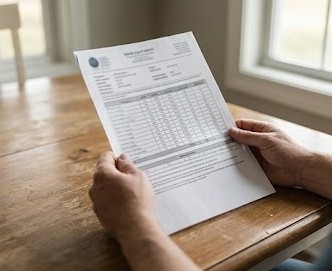
Most state-certified lab reports follow a similar format. You’ll typically see:
- Parameter name — what was tested (e.g., “Total Coliform”, “Nitrate as N”)
- Your result — the measured value (e.g., “0.8 mg/L” or “Not Detected” or “Absent”)
- Units — how the measurement is expressed (mg/L = milligrams per liter; CFU/100mL = colony-forming units per 100 milliliters; NTU = nephelometric turbidity units)
- MCL or SMCL — the regulatory limit
- Pass/Fail or a flag — some labs flag results that exceed the limit
If a parameter shows “ND” or “Not Detected”, that means the amount present was below the lab’s detection limit. This is a pass for that parameter. If it shows “<0.005 mg/L” (a value preceded by “<”), that also means not detected at that threshold.
Key Terms: MCL vs. SMCL
Every parameter has a reference standard. There are two types:
- MCL (Maximum Contaminant Level) — A legally enforceable health-based standard set by the EPA for public water systems. For private wells, these are used as reference guidelines, not laws. FHA, VA, and USDA loans use MCLs as their pass/fail standard.
- SMCL (Secondary Maximum Contaminant Level) — A non-enforceable aesthetic standard (taste, odor, color, staining). Exceeding an SMCL won’t cause illness but may affect the palatability of your water or damage appliances.
Parameter-by-Parameter Guide
Bacteria
| Parameter | Limit | What It Means | If You Fail |
|---|---|---|---|
| Total Coliform | Absent / 0 CFU/100mL | A broad indicator of bacterial contamination. Includes both harmless environmental bacteria and potential pathogens. Any detection requires investigation. | Shock chlorinate, re-test after 7–14 days. Full guide → |
| E. coli (Fecal Coliform) | Absent / 0 CFU/100mL | Confirms fecal contamination. A more serious finding than total coliform alone. Indicates possible sewage or animal waste intrusion into the aquifer. | Boil water advisory immediately. Shock chlorinate. Inspect well and nearby septic system. If recurrent, consult licensed well contractor. |
Inorganic Chemicals
| Parameter | MCL (mg/L) | What It Is | If You Exceed |
|---|---|---|---|
| Nitrate (as N) | 10 mg/L | From agricultural runoff, fertilizers, and septic systems. Dangerous for infants under 6 months (“blue baby syndrome”). Adults are not typically affected at levels up to 10 mg/L. | Do not give water to infants. Install reverse osmosis at kitchen tap or whole-house nitrate filter. Do not boil (boiling concentrates nitrates). |
| Nitrite (as N) | 1 mg/L | Similar source and effect to nitrate. More acutely toxic at lower concentrations. Less common than nitrate. | Same as nitrate—RO filtration at point of use. |
| Arsenic | 0.010 mg/L | Naturally occurring in bedrock in many regions (New England, Pacific Northwest, Upper Midwest). Long-term exposure linked to bladder and lung cancer. No taste or odor. | RO at point of use removes >90% of arsenic. Whole-house options: iron/manganese media filter, coagulation-flocculation. Test every 1–2 years if naturally elevated in your area. |
| Lead | 0.015 mg/L (Action Level) | Usually not in the water source itself—most often comes from lead solder or lead service lines in the home’s plumbing. Homes built before 1986 are highest risk. | Flush cold water for 30 seconds before use. Install NSF-53 certified filter at point of use. Consider plumbing inspection if levels are above 0.015 mg/L. |
| Iron | 0.3 mg/L (SMCL) | Common in groundwater. Not a health hazard at typical concentrations but causes rust-orange staining on fixtures, laundry, and appliances. Affects taste and odor. | Iron filter (oxidizing filter or greensand) or water softener depending on iron form (ferrous vs. ferric). Above 5 mg/L typically requires an oxidizing filter. |
| Manganese | 0.3 mg/L (health advisory); 0.05 mg/L (SMCL) | Naturally occurring. Black or dark brown staining. EPA’s health advisory of 0.3 mg/L reflects concerns about neurological effects with long-term exposure above that level. | Oxidizing filter (greensand, Birm, MnO2 media) or sequestration at lower levels. Test annually in areas with naturally elevated manganese. |
| Hardness (as CaCO3) | No MCL. >120 mg/L = hard water | Calcium and magnesium content. Not a health concern but causes scale buildup in water heaters, pipes, and appliances. Reduces soap lather. | Water softener (ion exchange) for hardness above 120–180 mg/L, especially if you have a tankless water heater or dishwasher. |
| pH | 6.5–8.5 (SMCL) | Measure of acidity/alkalinity. Below 6.5 = acidic, which can leach copper and lead from plumbing. Above 8.5 = alkaline, which causes scale. | Low pH: acid neutralizer (calcite filter) or soda ash injection. High pH: CO2 injection or blending. Low pH is the more common and more serious issue. |
| Fluoride | 4.0 mg/L (MCL); 2.0 mg/L (SMCL) | Naturally occurring in some aquifers. Above 2 mg/L can cause dental fluorosis (brown staining on teeth); above 4 mg/L increases risk of skeletal fluorosis. | Reverse osmosis or activated alumina filter at point of use. |
Physical Properties
| Parameter | Standard | What It Means |
|---|---|---|
| Turbidity | <1 NTU recommended; <4 NTU for disinfection to work effectively | Cloudiness. High turbidity can indicate surface water intrusion, a deteriorating well casing, or particles that shield bacteria from UV disinfection. |
| TDS (Total Dissolved Solids) | <500 mg/L (SMCL) | Total of all dissolved substances. High TDS can affect taste and indicate elevated levels of specific minerals. Not a direct health indicator but useful as a screening value. |
| Conductivity | Varies by source; typically <800 µS/cm | Electrical conductance of the water. Related to TDS. Used as a quick screening indicator—high conductivity suggests high dissolved solids. |
FHA / VA / USDA Pass Standards at a Glance
For federally-backed loan transactions, your results must meet these minimums:
| Parameter | FHA | VA | USDA |
|---|---|---|---|
| Total Coliform | Absent | Absent | Absent |
| E. coli | Absent | Absent | Absent |
| Nitrate | ≤10 mg/L | ≤10 mg/L | ≤10 mg/L |
| Lead | ≤0.015 mg/L | ≤0.015 mg/L | ≤0.015 mg/L |
| pH | 6.5–8.5 | 6.5–8.5 | 6.5–8.5 |
| Additional parameters | Per local health authority | Per VA appraiser / local health authority | Per state USDA office |
Recommended Tool: A Digital TDS Meter
An annual certified lab test is still the only result that's legally accepted for loan and health department purposes — a DIY meter can't replace that. But between annual tests, a simple handheld TDS (total dissolved solids) meter lets you spot-check your water in seconds and notice if something has changed before your next scheduled test.
Check Current Price on Amazon →As an Amazon Associate, we earn from qualifying purchases.
How to Get a Second Opinion on Your Results
If your results are borderline or unexpected, you have options:
- Re-test at the same lab — Request a second sample analysis. Labs occasionally have equipment issues or processing errors.
- Test at a different certified lab — Different labs use slightly different methodologies. A second lab can confirm or dispute a borderline result.
- Contact your state health department — Most state drinking water programs offer free consultations to interpret private well results and recommend next steps.
- Use our free interpreter tool — Enter your values and see instant plain-language results →